
An anaerobic reactor that does not spend its life being cleaned
A scale-free anaerobic reactor is the front end of any plant treating a high-strength organic load. MASF is engineered against the scaling that takes conventional reactors out of service. It is also built in a factory rather than on your site.
What is a scale-free anaerobic reactor?
A scale-free anaerobic reactor is an anaerobic treatment vessel engineered so that mineral scale does not accumulate on its internals and surfaces.
That matters because scaling, not biology, is what usually takes an anaerobic reactor out of service on a difficult wastewater.
MASF adds a second property: it is modular. The unit is prefabricated in a factory and assembled on site, rather than built in place over many months.
Anaerobic reactors rarely fail biologically
The bacteria are usually fine. It is the calcium that stops the plant.
On a strong, mineral-rich wastewater, carbonate and phosphate precipitate inside the reactor. Scale builds on the internals and the distribution goes uneven. Short-circuiting starts, and the conversion the design assumed no longer happens.
So the cost of a fouled anaerobic reactor is not the cleaning. It is the electricity every downstream blower burns for the rest of the year, on a load that should never have reached it.
Modular, and built where modules are built well
MASF is engineered so that the conditions driving scale do not establish themselves inside the vessel. That is a design property, not a dosing programme, so it never becomes an operating cost.
It is also prefabricated. Core units are built in our factory and assembled as modules on site. The construction programme shortens, the footprint shrinks, and most of the quality variation of field construction disappears.
The scaling that normally sets the cleaning interval on an anaerobic reactor is designed out rather than managed.
On a plant that runs continuously, an interval that does not exist is worth more than one that has been extended.
Where it is applied
Landfill and waste-to-energy leachate
Strong, mineral-rich organic loads. Conventional anaerobic reactors scale within the first years of operation.
Food and fermentation effluent
High organic strength, with the calcium and phosphate that drive precipitation inside the vessel.
Modular and fast-track projects
Sites where the construction programme, not the process, is the binding constraint.
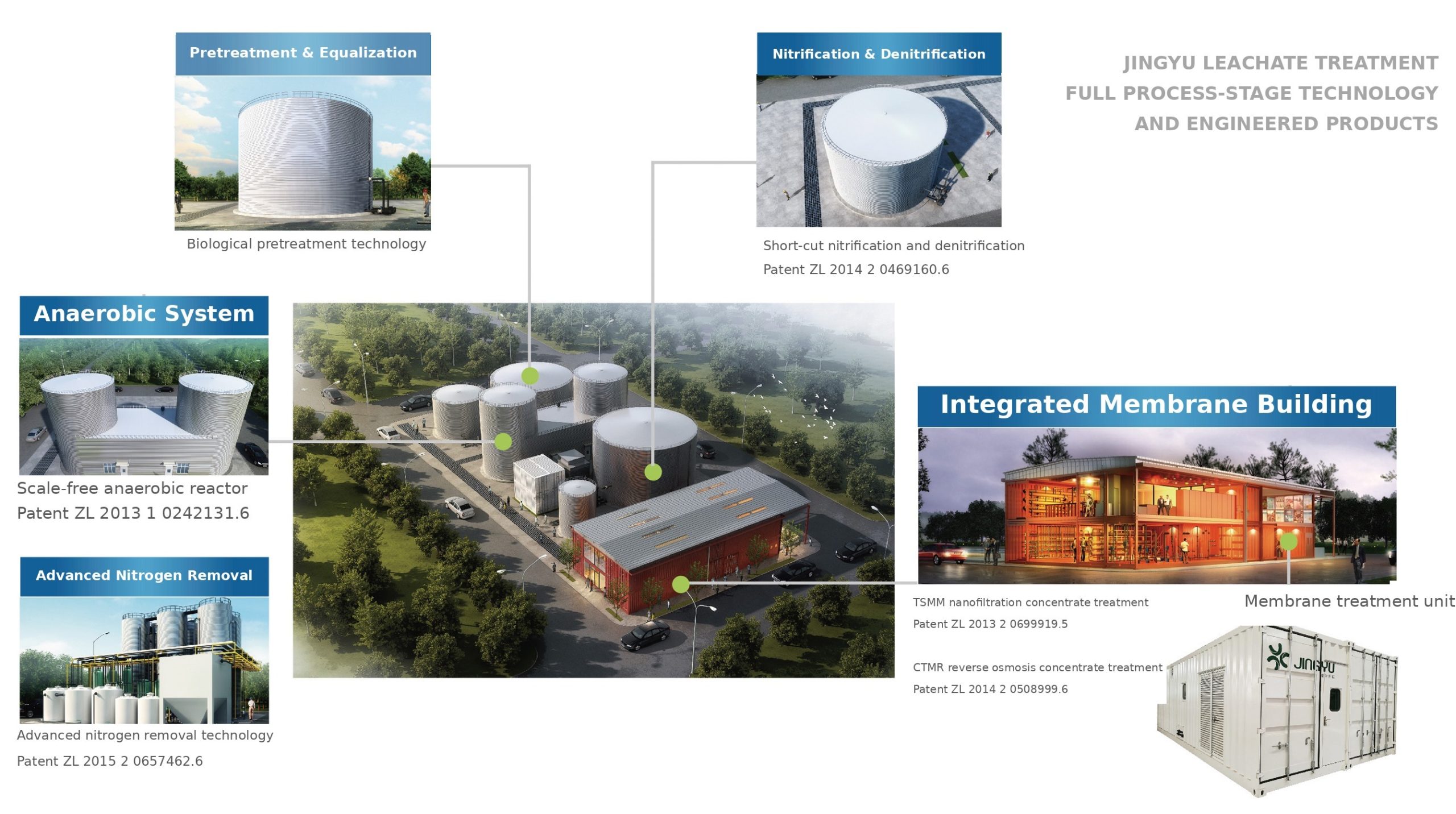
MASF sits at the front of the chain, ahead of short-cut nitrogen removal and advanced nitrogen removal. What it converts is load those stages never see.
Frequently asked questions
What does scale-free mean here?
It means the reactor is engineered so that mineral scale does not accumulate on its internals. Scaling is the usual reason an anaerobic reactor loses performance on a difficult wastewater. Designing it out is cheaper than cleaning it off.
Why does anaerobic treatment matter so much?
Because it converts organic load without aeration. Every kilogram of COD removed anaerobically is a kilogram the aerobic stage never has to blow air at. Aeration is one of the largest power consumers in a plant.
What does modular mean in practice?
Core units are prefabricated in our factory and assembled on site as modules. The programme shortens, the footprint shrinks, and build quality stops depending on site conditions.
Is it patented?
Yes, under Chinese patent ZL 2013 1 0242131.6.
Where does it sit in a leachate plant?
At the front, ahead of the aerobic and nitrogen removal stages. It is the anaerobic system module in our modular leachate plants.
Can it be added to an existing plant?
Where there is space and the hydraulics allow it, yes. More often it is part of a new plant or a full retrofit, because the stages after it are sized on what it removes.
Send us your COD figures
Start here
If your anaerobic stage is losing conversion, the cause is usually mineral rather than biological. Send the numbers and we will tell you which it is.
Useful to include
- Flow and COD, total and soluble
- Calcium, magnesium, phosphate and alkalinity
- Current anaerobic reactor type and its cleaning interval
- Temperature range
- Whether this is a new plant or a retrofit
Contact us directly
- info@jing-yu.com
- Phone
- +86 21 6593 0816
- Office hours
- Monday to Friday, 9:00 to 18:00 Shanghai time (GMT+8)