The stream that decides whether a leachate plant works
Nanofiltration concentrate treatment is where most leachate plants quietly lose their recovery. TSMM takes the organics out in two membrane stages instead of pushing them back around the loop. Total recovery reaches around 90%.
What is nanofiltration concentrate treatment?
Nanofiltration concentrate treatment is the step that handles the stream a nanofiltration unit rejects. That concentrate carries the refractory organics and much of the salt load.
Treating it properly means two things. Reduce its volume, and pull the organics out so the water still in it can be recovered rather than recirculated forever.
This is not a peripheral polishing step. On landfill and waste-to-energy leachate, it decides whether the whole plant holds its design output.
Why concentrate is where plants fail
The membrane rack gets replaced. The problem was never the membrane.
A leachate plant that recirculates its nanofiltration concentrate is storing up a problem. The refractory organics in that stream have nowhere to go. Sent back to the front of the plant, they accumulate in the membrane loop.
Within months of a membrane change the same thing happens again, because the cause sat upstream all along. Those organics are a small fraction of the stream by mass. Removing them beats chasing them with more pressure or more oxidant, and it is the cheapest intervention available in the whole plant.
How TSMM works
TSMM stands for twin-stage material membrane. Two material membranes in series reduce and recover nanofiltration concentrate.
The logic runs through all our high-salinity work: separate first, treat second. Oxidizing or evaporating a stream that still holds its foulants pays energy to destroy molecules a membrane could have removed far more cheaply. The same principle sits inside OROX on industrial brine.
Concentrate treatment is not judged on its own performance. It is judged on what the whole plant recovers once it is running.
The reverse osmosis membrane system yields 75% product water. Its concentrate, 25% of the flow, passes through pretreatment and an RO concentrate system that returns a further 15%.
Why the last 10% matters
That last 10% matters as much as the first 90%. A plant that sends 25% of its flow to a tanker carries an operating cost that never goes away. A plant that sends 10% to a crystallizer produces a solid instead. On the industrial side that solid is often a saleable salt rather than a disposal item.
Where it is applied
Landfill leachate
The classic case. Concentrate recirculation is the standard failure mode of aging leachate plants, and the standard reason their output drifts.
Waste-to-energy leachate
Incineration plants run continuously and cannot tolerate a water system that loses capacity. Concentrate reduction protects site availability.
Retrofits of existing plants
TSMM can be added to a plant already built and already struggling, without rebuilding the stages ahead of it.
Frequently asked questions
What is nanofiltration concentrate treatment?
It is the step that handles the stream a nanofiltration unit rejects. That concentrate carries the refractory organics and much of the salt load. In a leachate plant it is where recovery stalls. Treating it means reducing its volume and pulling the organics out, so the water in it can still be recovered.
Why does NF concentrate cause plants to fail?
Because the organics in it have nowhere to go. Recycled to the front of the plant, they accumulate in the membrane loop until fluxes collapse. The unit that fails is the membrane rack, but the cause is the concentrate handling.
How does TSMM differ from simply adding more RO?
More reverse osmosis pushes against the same organics. TSMM removes them first. Stage one separates and concentrates the organics. Stage two then recovers water from the stream that is left. Taking the foulant out is not the same as pressing harder against it.
What overall recovery is achievable?
On leachate, around 90% of total flow is recovered as product water. The remaining 10% goes to evaporation and crystallization, or to on-site disposal. In the loop shown here, the RO system yields 75% and concentrate reduction adds a further 15%.
Is the technology patented?
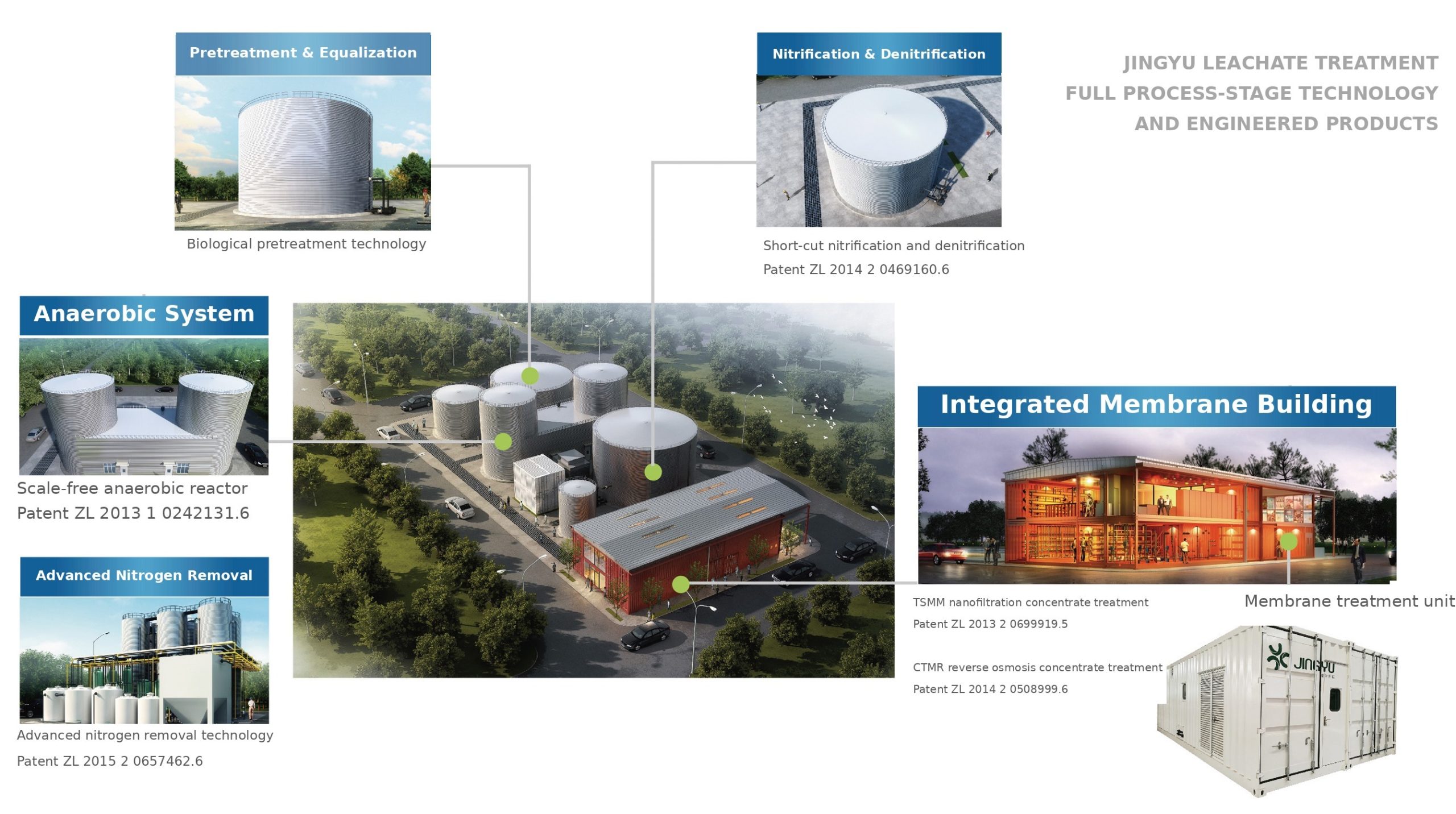
Yes. TSMM nanofiltration concentrate treatment is covered by Chinese patent ZL 2013 2 0699919.5, and the reverse osmosis concentrate treatment stage by ZL 2014 2 0508999.6.
Where is this used?
Landfill and waste-to-energy leachate above all, where nanofiltration concentrate is the standard bottleneck. The same principle, separation before oxidation or thermal treatment, also runs inside our OROX package on industrial brine.
Send us the concentrate, not the brochure request
Start here
If your leachate plant is losing output, the answer is usually in the concentrate analysis, not the membrane specification. Send it and we will tell you what we see.
Useful to include
- NF concentrate flow and its share of total flow
- COD, and how much of it is refractory
- TDS and conductivity
- Current recovery, and the recovery you need
- Cleaning frequency and how it has changed
Contact us directly
- info@jing-yu.com
- Phone
- +86 21 6593 0816
- Office hours
- Monday to Friday, 9:00 to 18:00 Shanghai time (GMT+8)