
Every stream accounted for, down to the last 10%
Leachate zero liquid discharge means nothing leaves the site as liquid. Ninety percent of the flow comes back as reusable water. The rest is crystallized into sodium chloride and potassium chloride. Even the condensate goes back into the loop.
What is leachate zero liquid discharge?
Leachate zero liquid discharge is a configuration in which no liquid leaves the plant. MBR effluent passes into advanced treatment and the permeate is reused. Both concentrate streams are reduced rather than trucked away.
The small fraction that remains is evaporated and crystallized into solid salt. The condensate from that step returns to the reuse loop.
The definition is easy. Holding it at 90% recovery, on a water as variable as leachate, is the part that takes engineering.
Two concentrates, two different problems
A leachate plant is only as good as the two streams it rejects.
The permeate side is the easy half. Nanofiltration and reverse osmosis are mature, and the water they make is fine. What decides the plant is the two concentrates they leave behind. Those two streams fail for completely different reasons.
So the two streams get separate treatment. TSMM takes the organics out of the nanofiltration concentrate. CHEMRO takes the scale out of the reverse osmosis concentrate. Together they are what turns a 75% plant into a 90% one.
Where every percent goes
This is the configuration we run most often on leachate. Read it as a balance sheet rather than a flow sheet. The argument for zero liquid discharge is made in the percentages.
Nanofiltration splits the flow 80 to 20. The larger share goes forward to reverse osmosis. The smaller share enters the TSMM system. Two material membrane stages there return 15% to the main line, send 4.5% back to the biological stage, and take 0.5% out of the plant as a concentrated organic fraction.
Two membrane trains and two concentrate stages, adding up to 90% of the leachate returned as reusable water.
The remaining 10% is not a loss. It is the feed to a crystallizer, and it comes out as a product with a specification.
What comes out at the end
Evaporation and crystallization turns the residual concentrate into sodium chloride and potassium chloride. The evaporator condensate is clean water and goes back to reuse. Nothing at the end of the train is wasted either.
This is where leachate treatment stops being a disposal exercise. A plant that hauls concentrate away carries that cost forever. A plant that crystallizes it produces a solid instead, and on the industrial side those solids are frequently saleable salt.
The stages behind the balance
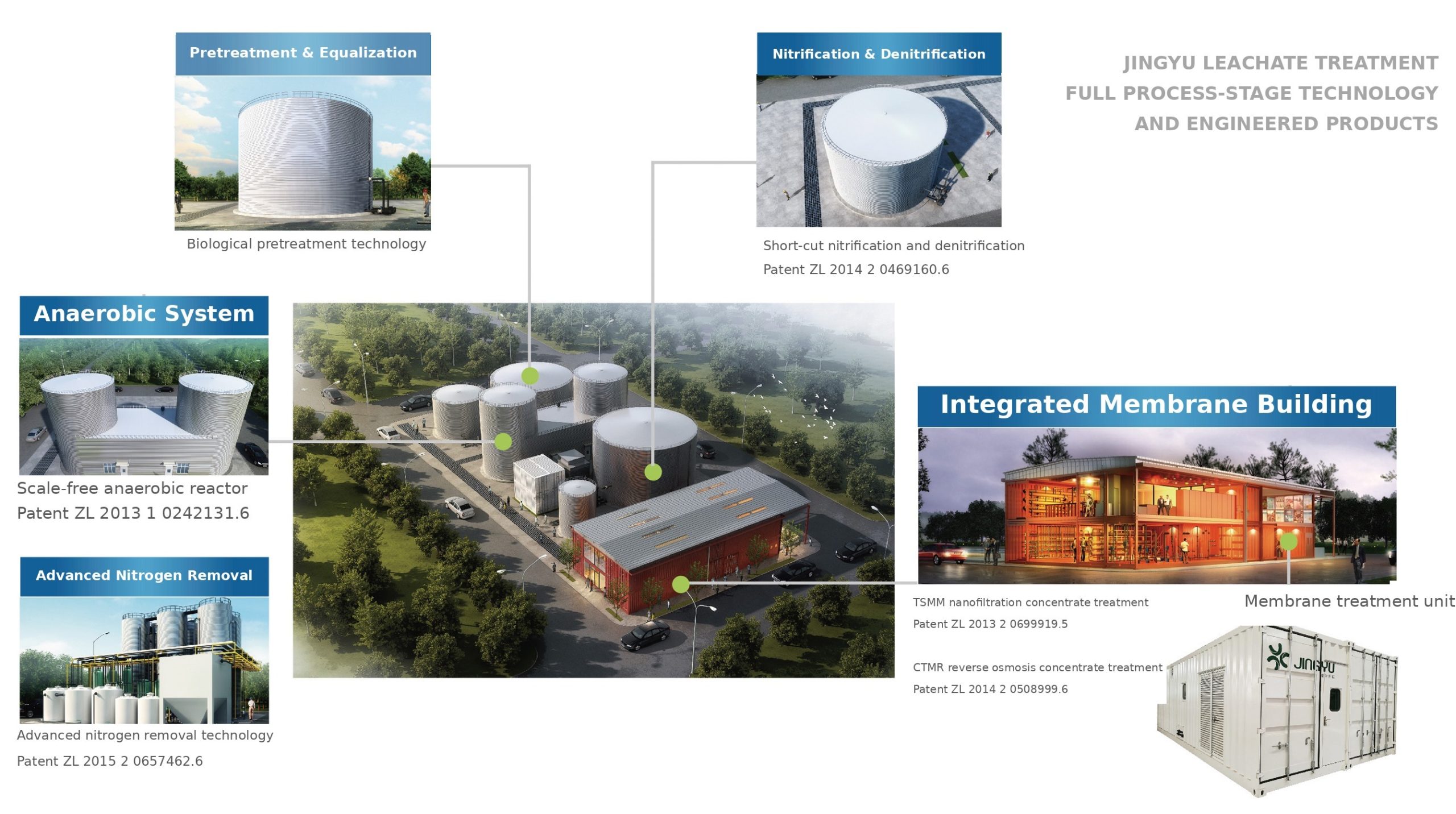
Every percentage on the diagram above depends on the stages ahead of it holding their design. Biological pretreatment, anaerobic treatment, short-cut nitrification and denitrification, and advanced nitrogen removal all sit upstream. Each is a patented, productized package rather than a one-off design.
Frequently asked questions
What is leachate zero liquid discharge?
It is a configuration in which no liquid leaves a leachate plant. MBR effluent goes to advanced treatment and the permeate is reused. Both concentrate streams are reduced, and the small residual fraction is crystallized into solid salt. The condensate from that step returns to reuse.
What overall recovery is achieved?
Around 90% of the leachate is recovered as reusable water. Reverse osmosis contributes 74.5% directly and the CHEMRO concentrate stage returns a further 15%. The remaining 10% goes to evaporation and crystallization.
Why are there two separate concentrate systems?
Because the two concentrates fail for different reasons. NF concentrate is limited by refractory organics and is handled by TSMM. RO concentrate is limited by scaling and is handled by CHEMRO. One technology applied to both would underperform on at least one.
What salt comes out at the end?
Sodium chloride and potassium chloride. The crystallization stage takes the last 10% and produces solid product salt rather than a landfill waste. The condensate returns to the reuse loop.
What happens to the organic concentrate?
It is a very small stream, around 0.5% of total leachate. It leaves the loop as a concentrated organic fraction that can be recovered as a resource. Another 4.5% is post-treated and returned to the biological stage.
Can this be retrofitted to an existing leachate plant?
Usually yes. Most existing plants already have biological treatment, nanofiltration and reverse osmosis. What they lack is the two concentrate stages and the crystallizer. Those are the parts that get added.
Send us your leachate analysis
Start here
Tell us what the plant treats today and where it stops. We will come back with the balance your water can reach and what has to be added to get there.
Useful to include
- Leachate flow and its seasonal variation
- COD, ammonia and total nitrogen
- TDS, chloride, sulfate and hardness
- Current recovery and where the concentrate goes
- Which stages already exist on site
Contact us directly
- info@jing-yu.com
- Phone
- +86 21 6593 0816
- Office hours
- Monday to Friday, 9:00 to 18:00 Shanghai time (GMT+8)